GEO Check: Does ChatGPT, Claude, Gemini or DeepSeek Recommend Your Brand?
How GEO Check measures AI brand visibility: six buyer questions asked to four AI models, mention rate, share of voice, competitors named instead, nine site-readiness checks and an action plan.
A buyer who used to type “best invoicing app for freelancers” into Google now often asks the same thing in a chat window. Google shows ten links. An assistant gives one answer with three or four names in it. If your brand is not one of those names, you lost the visit before it started, and no analytics tool will tell you it happened.
GEO Check in Growth Atlas puts a number on that blind spot. You paste your website. It works out the questions your buyers ask AI assistants, asks four models each one, and shows how often they name you, who they name instead, and what to change on your site. This guide explains each number in the report using the illustrative sample on the GEO Check page, and it is direct about what the check can and cannot tell you.
Key takeaway
- GEO Check writes six buyer questions that never mention your brand and asks each one to four models: GPT-6.1 Sol, Claude Sonnet 5.5, Gemini 3.8 Flash and DeepSeek V4 Flash. That makes 24 answers per run.
- The GEO score is 40% AI visibility, 20% share of voice, 10% average position and 30% site readiness.
- Site readiness is nine checks on your live home page, robots.txt and llms.txt, including whether AI crawlers such as GPTBot and ClaudeBot are allowed.
- Every answer is shown in full with the brands it named, so you can check each number yourself.
- The models answer from their training, without live web search. ChatGPT or Gemini with search turned on may answer differently.
What GEO is, briefly
Generative engine optimisation (GEO) is getting your brand named and recommended inside AI answers. Where SEO competes for a place in a list of links, GEO competes for a mention in the one answer an assistant gives. The two overlap: clear pages, structured data and a good reputation on review sites help both. But a page can rank well in Google and still be absent from AI answers, and the reverse also happens.
What you enter
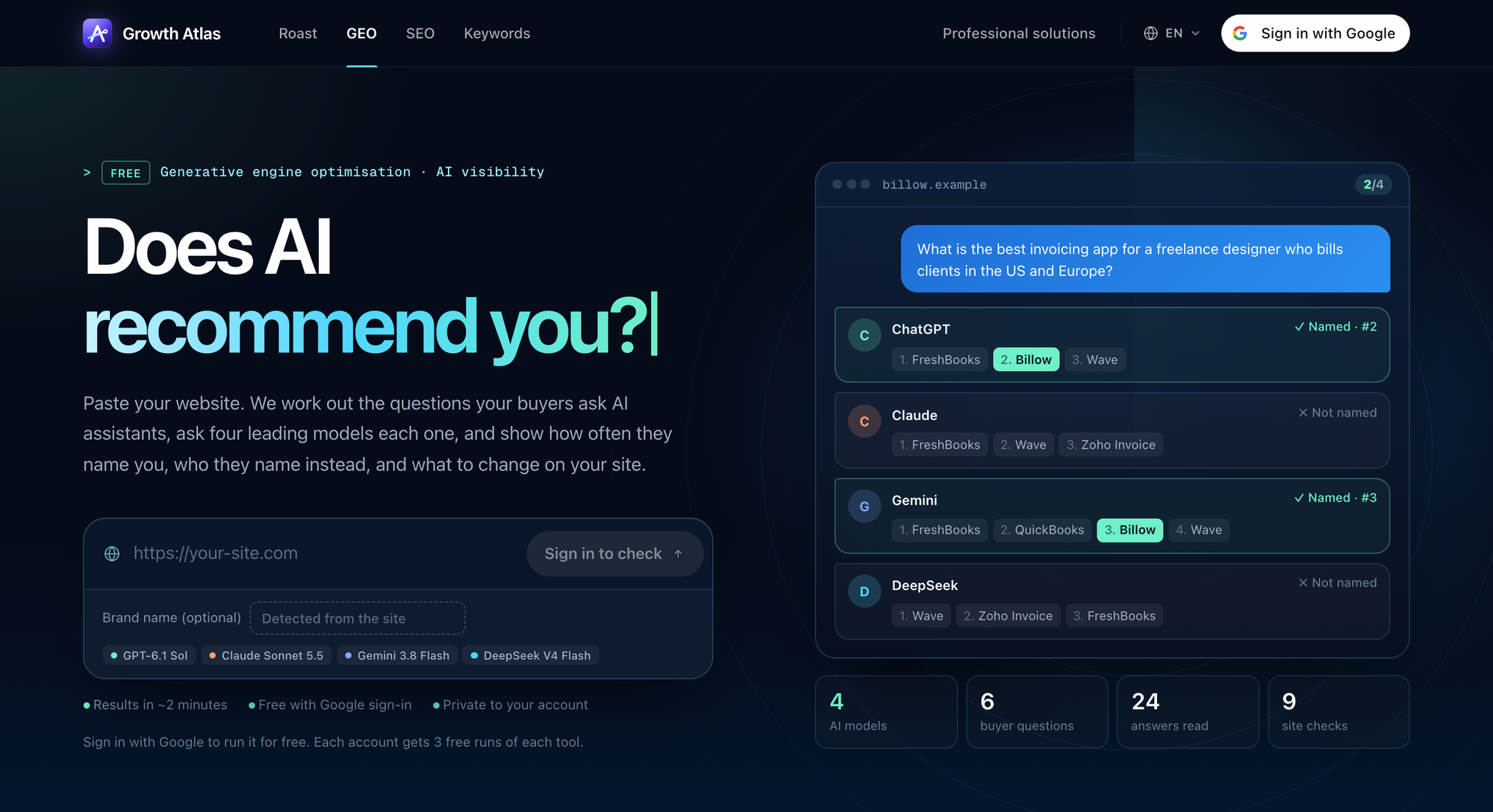 The GEO Check form on 2026-11-20. The preview on the right shows one question from the illustrative sample: two of four models name “Billow”, at positions 2 and 3.
You give it a website. The brand name is optional; by default GEO Check reads it from the site. Set it yourself when your brand name differs from your domain or when people know you by a product name.
How a check runs
- Read. Growth Atlas loads your public home page, robots.txt and llms.txt, and runs nine readiness checks.
- Ask. A model works out your brand, your category, your likely competitors and six buyer questions. The questions never name you, because the point is to see whether an assistant brings you up by itself. GPT, Claude, Gemini and DeepSeek each answer every question in a fresh chat.
- Score. Mentions, positions and share of voice are counted from the answers. An analyst model reads the tone toward your brand and writes the action plan.
The six questions mix intents the way real buyers do: two “best X for Y” questions, one concrete use case, one “alternatives to [the best-known competitor]”, one comparison between competitors, and one problem question that describes the pain without asking for a product. In the sample, the questions range from “What is the best invoicing app for a freelance designer who bills clients in the US and Europe?” to “Clients keep paying my invoices weeks late. How can I get paid faster?”
The problem question is usually the hardest to win. The buyer has not decided to buy software yet, and the assistant often answers with advice and only one or two product names.
The GEO score and what goes into it
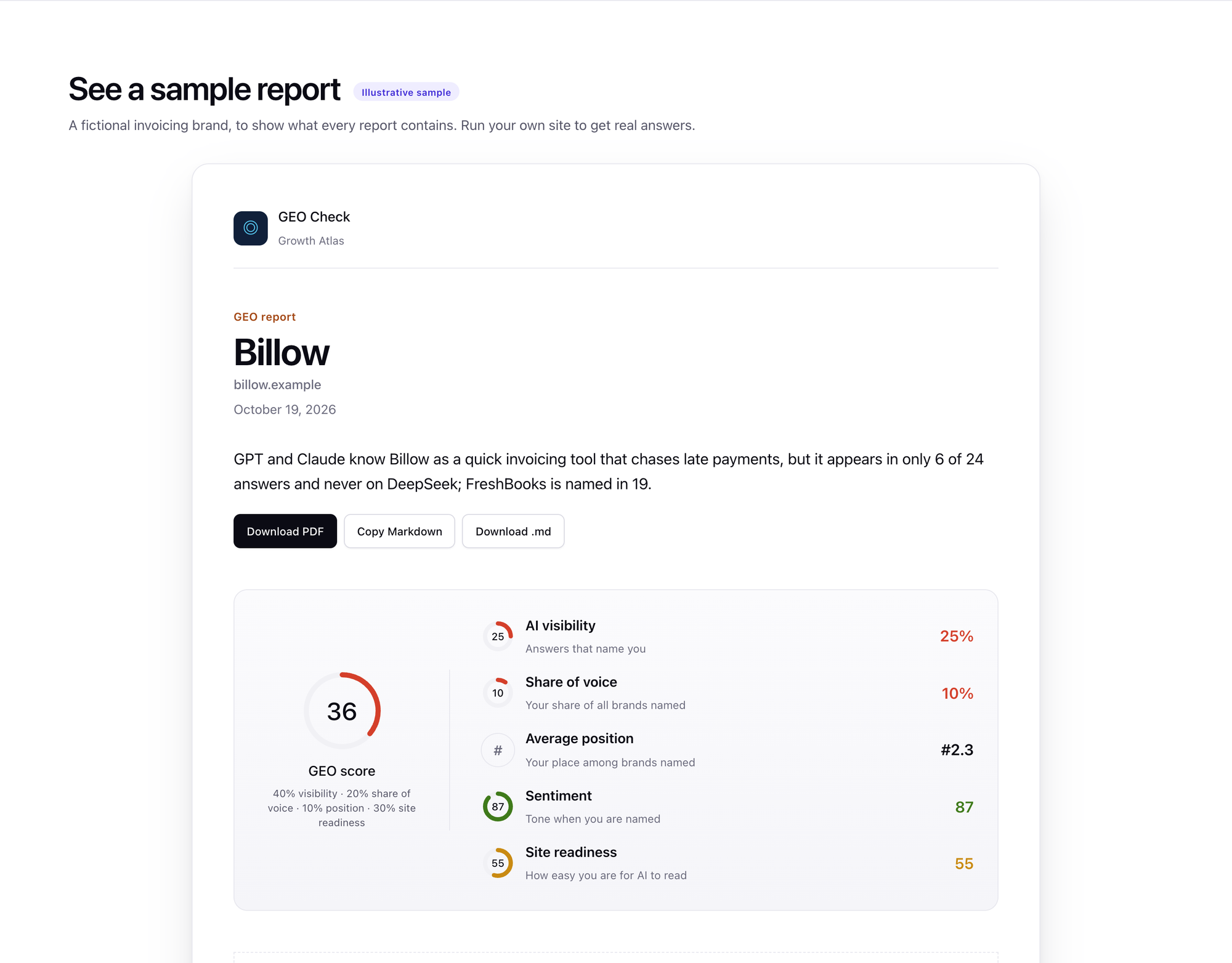 The illustrative sample (a fictional invoicing brand, “Billow”). The summary line says it appears in 6 of 24 answers and never on DeepSeek, while FreshBooks is named in 19.
The headline GEO score combines four parts:
| Part | What it measures | Weight |
|---|---|---|
| AI visibility | Share of answers that name you | 40% |
| Share of voice | Your mentions as a share of all brand mentions | 20% |
| Average position | Your place among the brands an answer names | 10% |
| Site readiness | How easy your site is for AI to read (nine checks) | 30% |
Sentiment, the tone of the answers that name you, is reported next to the score but is not part of it.
The sample lets you check the arithmetic. Visibility is 25 (6 of 24 answers). Share of voice is 10. The position part gives 100 for first place and 20 points less for each place below, so an average position of 2.3 scores 74. Site readiness is 55. That gives 0.4 × 25 + 0.2 × 10 + 0.1 × 74 + 0.3 × 55 = 35.9, shown as 36.
What the formula says in plain terms: being named at all matters most. Being named first matters much less than being named often. And about a third of the score is under your direct control today, through the site-readiness checks.
Visibility by model
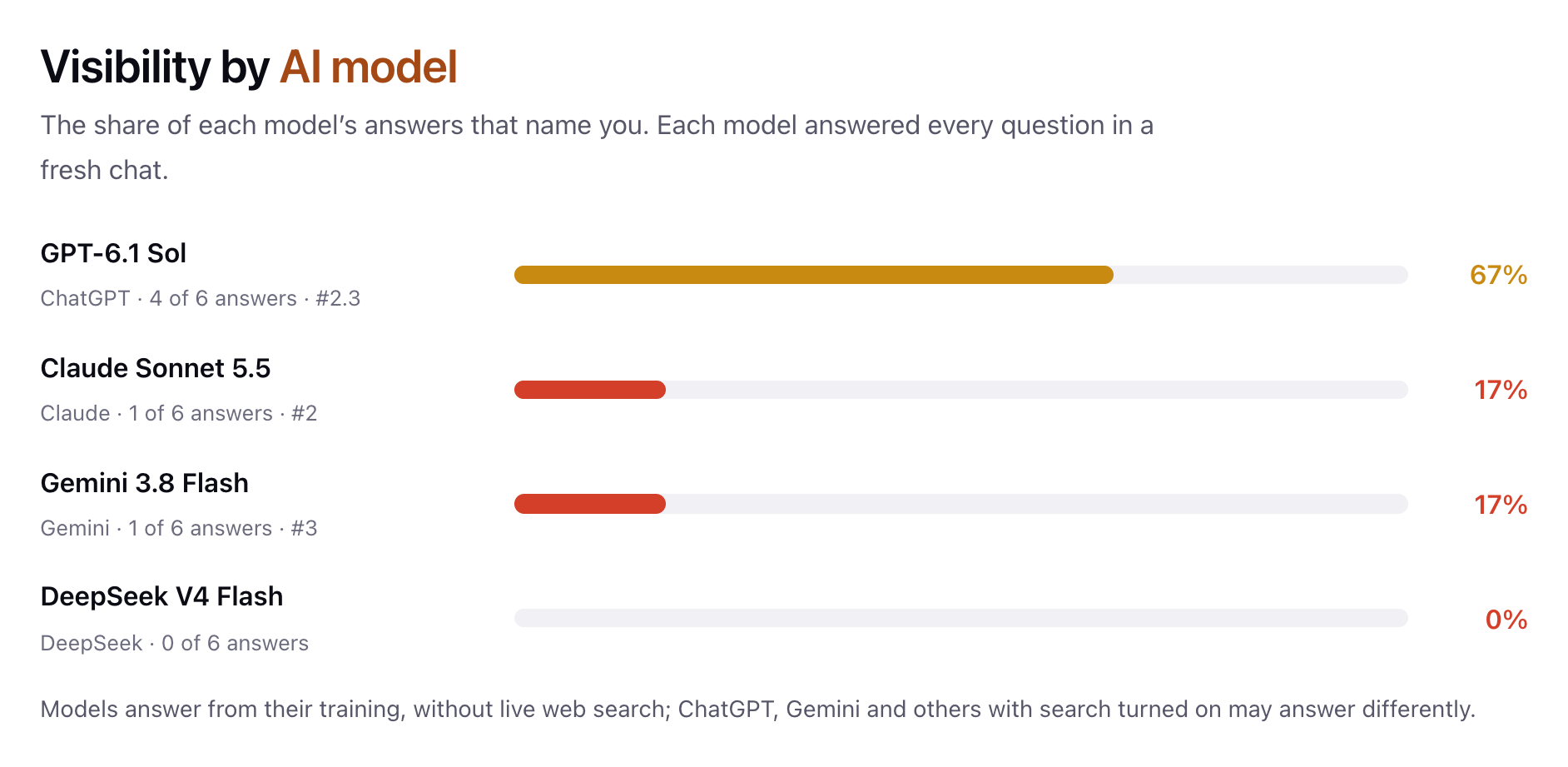 Visibility per model in the sample. The note under the chart is the most important caveat in the report: the models answer from training, without live web search.
The per-model split is often more useful than the overall number. Models are trained on different data at different times, so a brand can be well known to one and absent from another. In the sample, GPT names Billow in four of six answers and DeepSeek in none.
A gap like that points at different fixes. If one model knows you and another does not, the problem is usually coverage in the sources that model learned from, which is an authority problem (lists, reviews, mentions on other sites). If no model knows you, start with the basics: what your site says about you and whether crawlers can read it.
Below the chart, the report ranks every brand named across all answers. In the sample, FreshBooks is named in 79% of answers and Billow is fourth at 25%. That table is your real competitor list in AI answers, and it is often different from the competitors you track in Google.
You can also open each question and read all four answers in full, with a tick where you were named and your place in the answer. Every visibility, share-of-voice and position number can be traced back to these answers.
Real runs can show one more section that the fictional sample does not: Ahrefs counts of AI answers that cite (link to) pages on your domain, broken down by assistant, such as ChatGPT, Google AI Overviews, Google AI Mode, Perplexity, Gemini, Copilot and Grok. That data comes from Ahrefs’ tracking of real prompts, including assistants with search, and it counts links to your site rather than mentions of your brand name. It appears only when Ahrefs has seen your domain cited.
Site readiness: the part you control
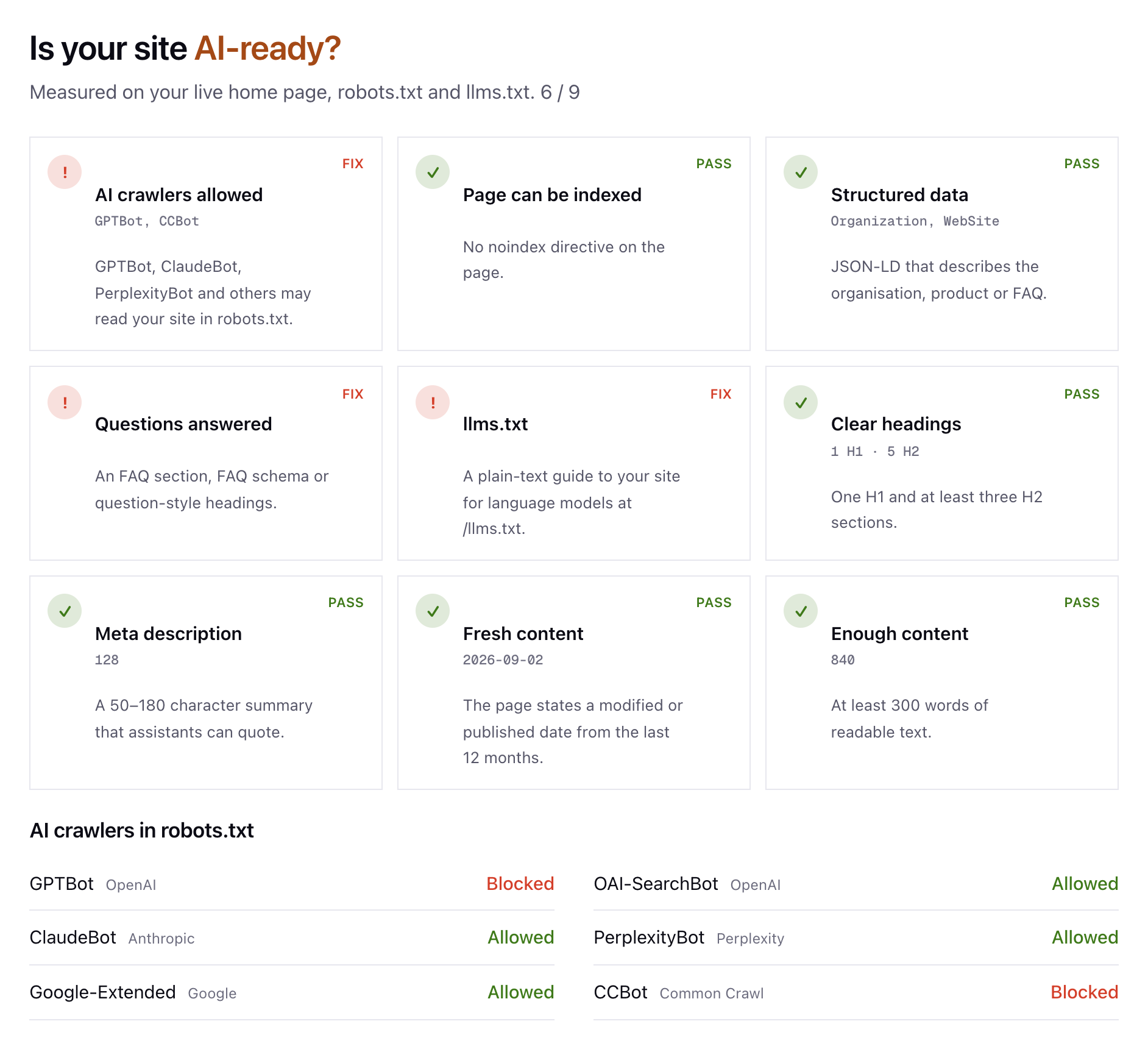 Site readiness in the sample: 6 of 9 checks pass. The robots.txt table shows GPTBot and CCBot blocked and the other four AI crawlers allowed.
The nine checks run on your live home page, robots.txt and llms.txt. They are weighted, and the weights add up to 100:
| Check | Passes when | Weight |
|---|---|---|
| AI crawlers allowed | robots.txt does not block GPTBot, OAI-SearchBot, ClaudeBot, PerplexityBot, Google-Extended or CCBot | 25 |
| Page can be indexed | No noindex directive | 15 |
| Structured data | Any JSON-LD on the page (for example Organization, Product or FAQPage) | 15 |
| Questions answered | An FAQ section, FAQ schema or question-style headings | 10 |
| llms.txt | A plain-text guide for language models at /llms.txt | 10 |
| Clear headings | One H1 and at least three H2 sections | 10 |
| Meta description | A 50–180 character summary | 5 |
| Fresh content | A published or modified date from the last 12 months | 5 |
| Enough content | At least 300 words of readable text | 5 |
In the sample, three checks fail: AI crawlers (25), questions answered (10) and llms.txt (10). That is 45 points, which is why site readiness is 55.
Crawler access carries the most weight, and it is usually a one-line fix in robots.txt. A rule that blocks GPTBot or CCBot is easy to miss when you did not write it yourself. CCBot feeds Common Crawl, a corpus that many models learn from. Before you change the rule, decide deliberately: allowing AI crawlers is a business choice about your content, not only a GEO tactic.
The action plan
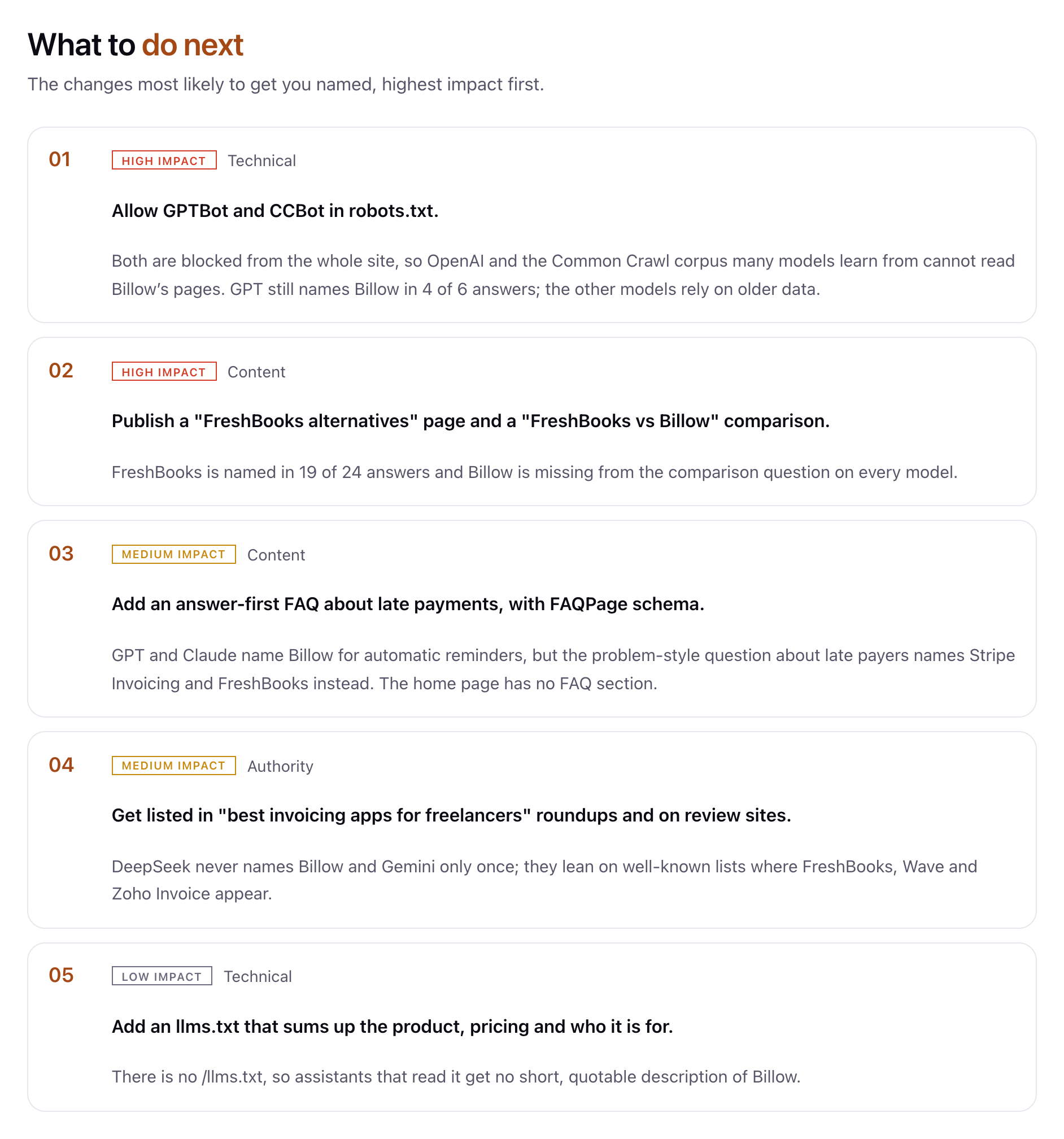 The action plan in the sample. Each action is tagged by impact (high, medium, low) and kind (technical, content, authority), and the reason cites the questions or checks behind it.
The report ends with four to six actions, highest impact first. Each one is tagged as technical (crawlers, schema, llms.txt), content (comparison pages, FAQ answers) or authority (getting listed where assistants learn about your category), and each reason is tied to the evidence above it.
The sample shows the pattern well. The competitor that wins most answers (FreshBooks) becomes the subject of the content actions: a “FreshBooks alternatives” page and a “FreshBooks vs Billow” comparison. The models that never name the brand become the reason for the authority action: get into the roundups and review sites those models rely on.
How to use GEO Check well
- Run it once as a baseline, then after real changes. With three free runs, a baseline, a check after the technical fixes, and a check a few months after new content is a reasonable plan. Model knowledge changes slowly for training-based answers, so do not expect content changes to show up within days.
- Read the answers, not only the score. How the models describe you matters as much as whether they name you. If they call you “an invoicing tool” and you sell payments, that is a positioning problem.
- Set the brand name if detection is off. If the profile shows the wrong brand or category, run again with the brand name filled in.
- Pair it with KeywordScout. The questions you lose often map to search terms. KeywordScout tells you whether those terms also have Google search volume, so one page can win both.
What GEO Check does not tell you
- It is not a copy of a user’s screen. The models are asked through their APIs, without live web search and without user history. Assistants with search turned on, or with personalisation, can answer differently.
- Six questions is a sample. It covers the main intents, not every query in your market. Model answers also vary from one run to the next, so a change of one or two mentions between runs is noise.
- Mentions are found by name. The analyst merges common variants, but a brand with a generic name can be over- or under-counted. Check the answers when a number looks surprising.
- No tracking over time. Each run is a snapshot. Compare two reports in your History to see a change.
FAQ
Which AI models does GEO Check ask? On 2026-11-20: GPT-6.1 Sol (ChatGPT family), Claude Sonnet 5.5, Gemini 3.8 Flash and DeepSeek V4 Flash, called through SandBase. You can see each model’s page on SandBase, for example GPT-6.1 Sol.
Is this the same as what ChatGPT shows? Not exactly. The 24 answers measure what the models know without web search. ChatGPT with search, Google AI Overviews and Perplexity also pull in live pages, so their answers can differ. The optional Ahrefs citation section is the part of the report that reflects search-enabled assistants.
Is it free? Yes. Sign in with Google and you get 3 free runs of GEO Check.
Can I check a competitor? Yes. Enter their site. The report then shows how often AI names them and who it names instead.
Is my report stored? It is saved to your account’s History, visible only to you, and you can delete it.
Try it
Run GEO Check on your site and read the answers your buyers would see. For how GEO Check fits with the website audit, SEO and keyword tools, see the Growth Atlas overview.
Sources: growatlas.ai/tools/geo and its illustrative sample report (fictional brand “Billow”, dated 2026-10-19), retrieved 2026-11-20. Models, weights and checks can change; the live tool page is authoritative.